Dayna’s Genealogy Toolkit

Dayna Jacobs, AG®   https://ongrannystrail.com/toolkit piktochart

This toolkit is full of my go-to links that are (mostly) not record repositories, but rather are tools to help me find, interpret, and organize my research and records. I think you’ll want to keep them handy, too.  If you have suggestions for tools I can add to the toolkit, I’d love to hear them.  Email me at ongrannystrail@gmail.com.

Abbreviations & Acronyms for Genealogy – What do they mean?

Abbreviations, Acronyms, Initialism & Postnominals in Genealogy – By NGS

Age Calculator – Calculate age based on the DOB and another date, by Cornell Univ.

Ancestor Search – Google search templates for genealogists, by Randy Majors

Archive Grid – Enter a zip code to identify nearby archives, find collections

Atlas of Historical County Boundaries – Identify U.S.  county boundaries at any point in history

BLM-GLO Records – Find U.S. federal land patents and locate parcels on a map

Census Enumerator Instructions – For U.S. censuses 1850-1940

Cheat Sheet – Boolean Genealogy Searches – Online searches made easy from OGT

Cheat Sheets – By Thomas MacEntee – A variety of helps

Cheat Sheet – Table of Wars and Ages of Servicemen –  Determine which war your ancestor might have been involved with

Citation Creator – EasyBib – Help for source citations

Cloud Convert – Convert files from one format to another

David Rumsey Digital Map Collection – Excellent map resource

DNA Painter – Tools for genetic genealogy

Earth Point township and range tools – Locate land in the public domain

Easy Google Genealogy Searcher – Google search templates for genealogists

Evernote – Organize your research

Family Relationship Chart – From the National Genealogical Society

Free Forms and Charts – Family Tree Magazine

Geographic Names Info System (GNIS) – Supercharged online gazetteer

Genetic Affairs – Tools for genetic genealogy

GPS Visualizer – Create .csv files of places in GNIS and import them to Google Earth

Historical Map Archive – A look back in time

Historical U.S. Counties on Google Maps – By Randy Majors

Internet Archive – For digitized county and family histories

Learning Center – Free online courses at FamilySearch

Linkpendium – Links to genealogy resources organized by locality

Map of US – Interactive map of the U.S. and county boundaries by year

National Archives and Records Administration (NARA) – Order land entry files and pension files

Newspapers – Library of Congress: Chronicling America

Newspapers by Locality – From the Ancestor Hunt

Obituary links by locality – From the Ancestor Hunt

PhotoTree – Help with photograph types and dating

QuickSheets – From The Ancestor Hunt

Research Guides – From the Newberry Library

Research Report Template – Download this editable template from OGT

Research Wiki – FamilySearch – Huge knowledge base for researchers

Resources by Locality – From the Ancestor Hunt

The Source: A Guidebook to American Genealogy – Online version of a classic

Timeline Template – Download this editable template from OGT

U.S. History Timelines and Chronologies

Vital Records – Where to write

Worldcat – Find libraries and items for interlibrary loan
The ICAPGen ℠ service mark and the Accredited Genealogist® and AG® registered marks are the sole property of the International Commission for the Accreditation of Professional Genealogists.  All Rights Reserved.

10 Million Names Project

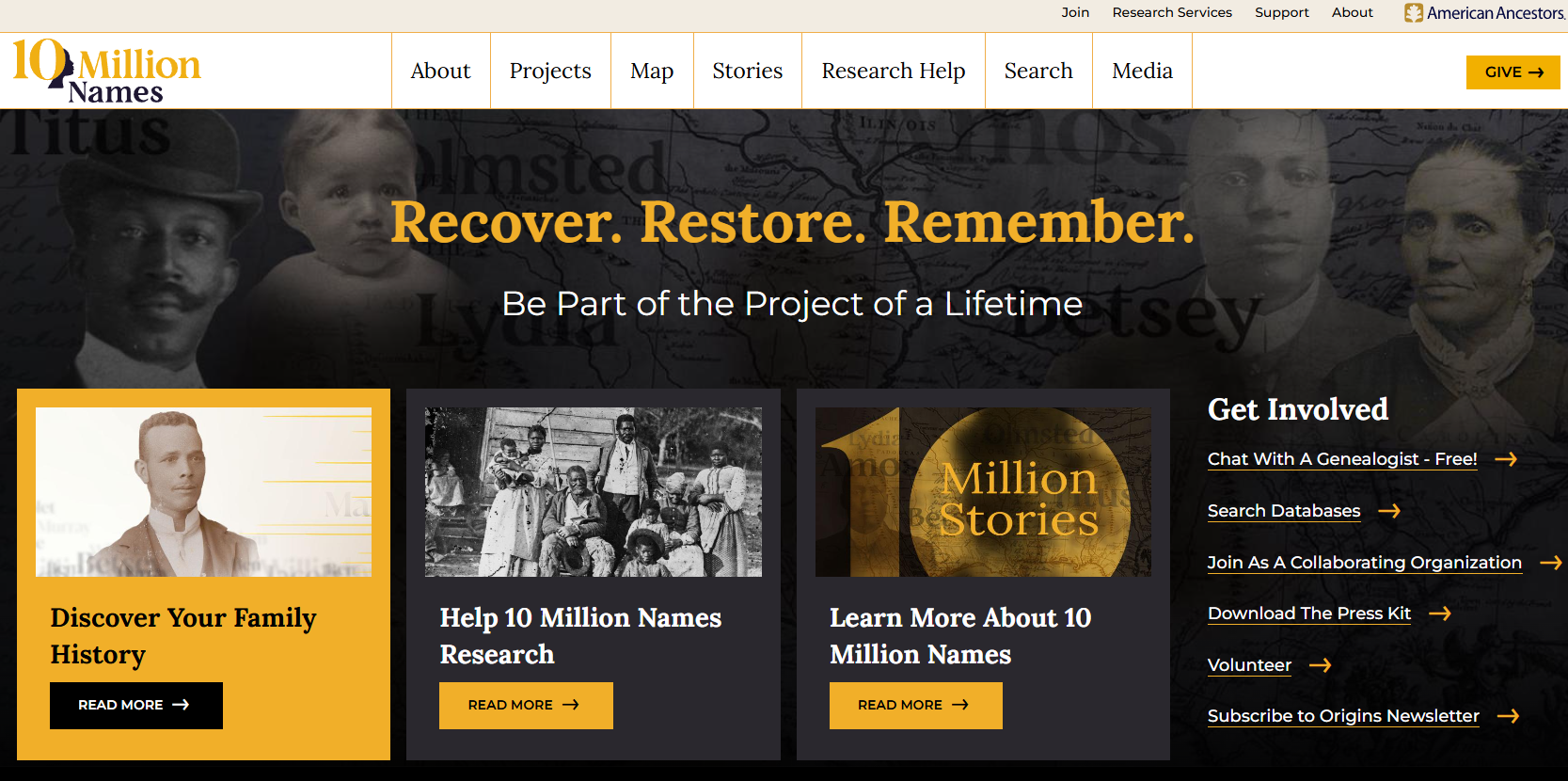
I want to highlight the 10 Million Names project here, for those who have not heard of it. It was launched in 2023 and I first heard of it when it was featured at RootsTech in 2024. I recently looked into it to see how I might volunteer. Here is their mission statement, as found on their website:

“10 Million Names is a collaborative project dedicated to recovering the names of the estimated 10 million men, women, and children of African descent who were enslaved in pre- and post-colonial America (specifically, the territory that would become the United States) between the 1500s and 1865.

The project seeks to amplify the voices of people who have been telling their family stories for centuries, connect researchers and data partners with people seeking answers to family history questions, and expand access to data, resources, and information about enslaved African Americans.”

The 10 Million Names project emerged as one of the top websites for African American genealogy in 2024, according to Family Tree Magazine. In addition to resources such as a free online course titled, “Getting Started in African American Family History Research,” there are research guides, free charts and templates, events and videos, links to cultural sites, and resources compiled by FamilySearch. Of note are the searchable databases accessible on the 10 Million Names website hosted by American Ancestors website.

I found it was easy to volunteer with 10 Million Names. They are very organized and respond to inquiries quickly. Here is what the website says about volunteer opportunities:

“Seeking volunteers who will help create content for 10MillionNames.org. Volunteers are needed to digitize images, which is done on-site at the American Ancestors Research Center in Boston, or as contributors to database projects, which can be done either on-site or from home. Volunteers work from handwritten or text documents, extracting information into a spreadsheet, or assist with proofreading the data. 10 Million Names team provides training; however, volunteers must possess a basic knowledge of Microsoft Excel. This is a great, “hands-on” way to learn the process of transferring printed material to the Internet. Students may inquire about internship opportunities.”

Contact: Danielle Rose, 10 Million Names Volunteer Coordinator

I contacted Danielle Rose at the link above, and was given an option to participate in one of four projects. I am currently reading through Missouri deed records in my assigned county and deed book and extracting names of enslaved persons mentioned there, along with other data. I can see how there is a need for many volunteers to join in this worthwhile work, and there are opportunities for researchers of varied experience levels.

Geo Hints and the BYU Family History Technology Lab

A friend introduced me to a tool that has become a bit of an obsession for me lately. It is called Geo Hints, and is a creation of the BYU Family History Technology Lab (BYU FHTL). Brigham Young University has an outstanding Family History department and library. If you have not explored the BYU Library Family History website before, it is worth a visit. Along with the many links to online resources, they offer free classes and webinars and have a virtual family history help desk.

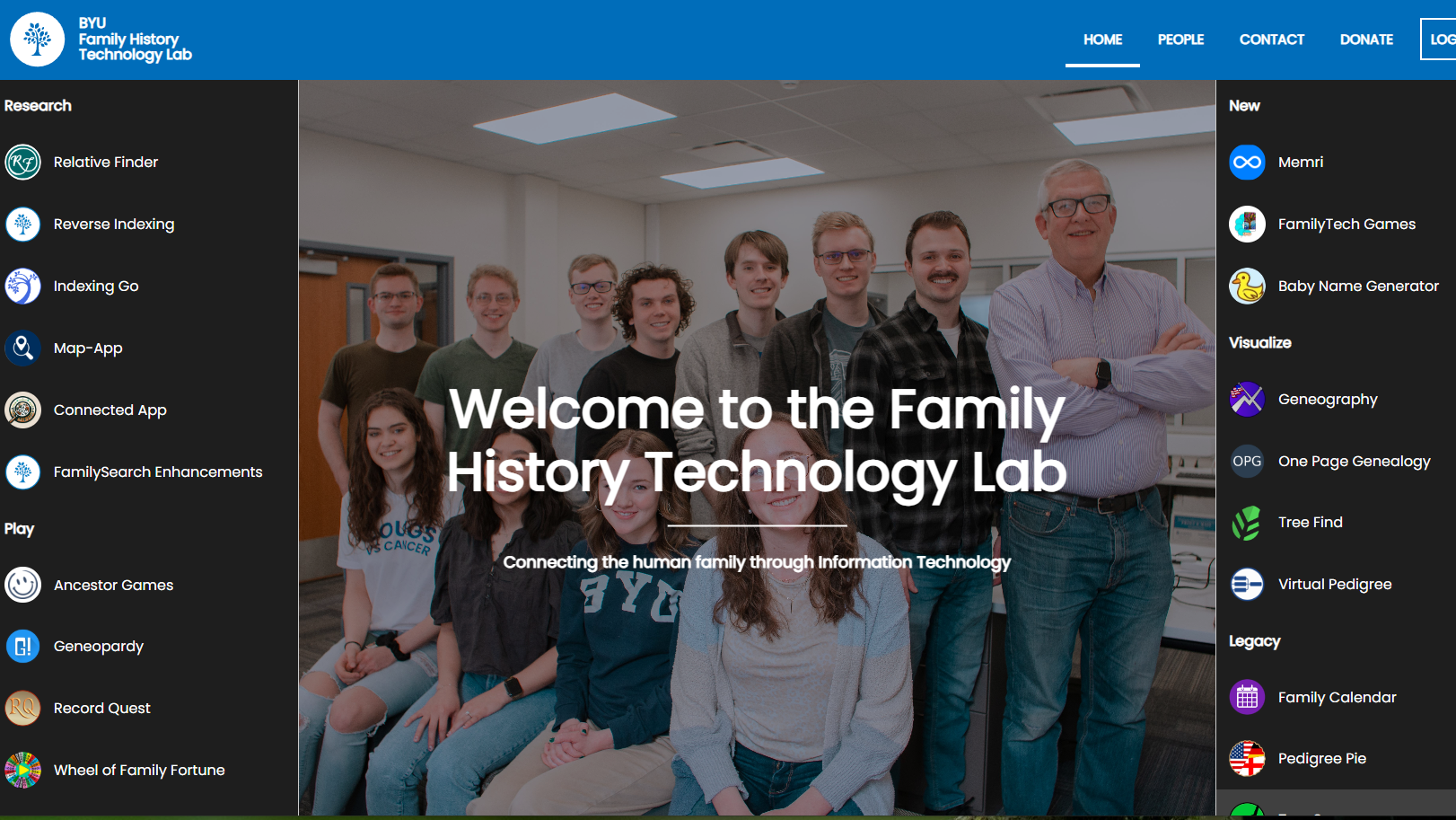
But this post is about the BYU Family History Technology Lab and some of their fun offerings. They have created a collection of apps and games that use the FamilySearch Family Tree to help you see your ancestors and research in a whole new way.

One of my favorites is “Wheel of Family Fortune.” The description says, “It pays to know your family history. Wheel of Family Fortune is the classic party game that tests how well you know your ancestor’s names. Play alone, or add other players to create a fun game for the whole family!” I also love the Pedigree Pie which lets me visualize my international heritage. Tree Sweeper helps to identify errors in my family tree so I can fix them, and Tree Find is an easy way for me to search my tree for ancestors who meet certain criteria such as locality. That would have come in handy on a recent vacation I took, had I known about it. Family Calendar lets me add important events from my family history to my Google or Apple calendars. And then there’s Geneopardy, a game that will test my knowledge of my family tree. I’ll have to try that one when I’m alone, so I don’t embarrass myself.

But my new favorite is Geo Hints, formerly known as Map-App. It can be accessed directly through this link, or you can find it still as Map-App on the BYU FHTL site.

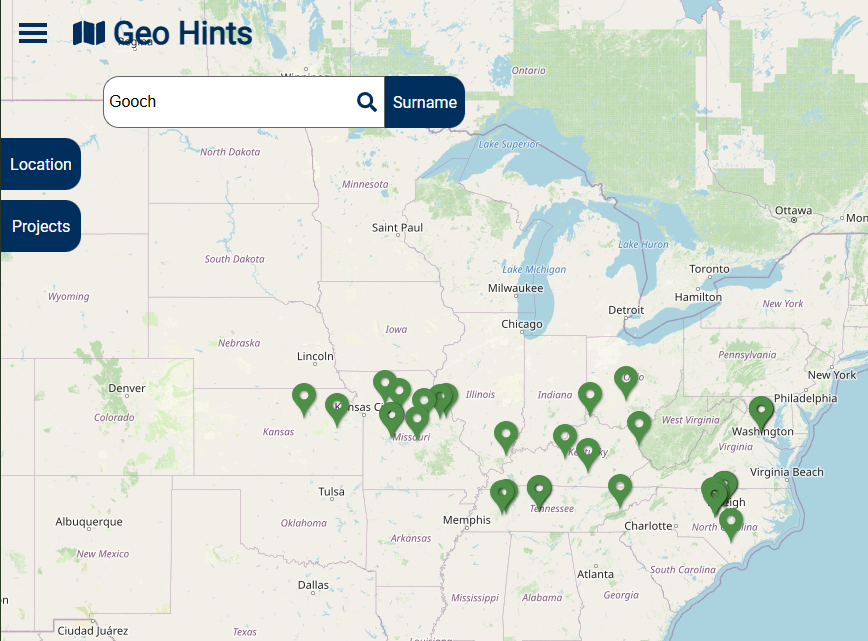
Geo Hints connects to the FamilySearch family tree and brings up indexed records that need to be attached to the tree. I can search by surname, location, or project to find these records. I enjoy searching by my maiden name, Gooch, because it is so satisfying to see Gooch records and attach them to all the Gooches in the tree. Here’s what the search and results looked like when I tried it today.

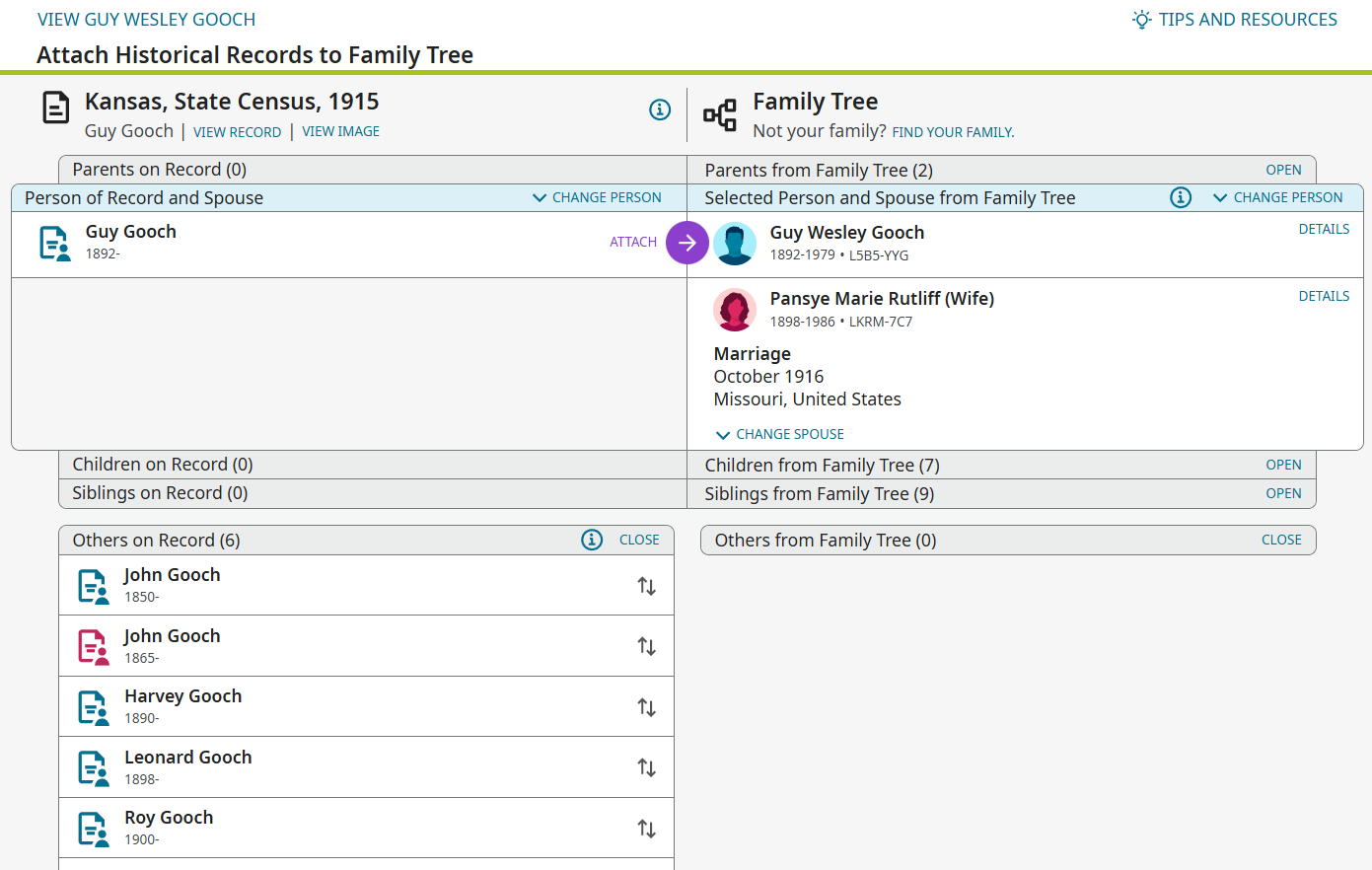
Each green marker represents a record, and the markers disappear after you attach the record to the tree. My obsession stems from my attempts to clear all the markers from the map. Clicking on one of the Kansas markers I was shown this screen:

Expanding the view to include Guy’s siblings I could easily see this 1915 State Census entry was for the family on the right, and I was able to attach it. Even though it is not my Gooch family, I hope that attaching this record will help some other researcher and will result in good genealogy karma. And it’s something that is easy to do while watching a football game or Jeopardy on television. Family Search recently sent me a summary of my contributions to the worldwide family tree this year and I was shocked to see I have added 1,528 individuals and 11,593 sources! Do I really watch that much television? This makes it guilt-free in my book. Hooray! And hooray for the BYU FHTL and their creations. Yes, genealogy IS fun!

NARA’s free online Genealogy Series begins today

The line-up of presentations did not get included in the “re-blog” above, so I am adding it here. The handouts are also excellent, and can be found on YouTube below the link to the presentation.

  • Passport Records: Passport Applications at NARA, 1790s-1925 – May 21, 1 p.m. ET
  • After Their Service: Tracing the Lives of Native American Army Scouts – May 28, 1 p.m. ET
  • Captured German Records Related to American Prisoners of War During World War II – June 4, 1 p.m. ET
  • Alien Files (A-Files): Researching Immigrant Ancestors at the National Archives – June 18, 1 p.m. ET
  • World War II Enemy Alien Records Related to Japanese Americans at the National Archives – June 25, 1 p.m. ET

Plans of Military Posts in the United States, 1840–1947

Records held by the National Archives are valuable for Western States researchers. Think about it: beginning with California in 1850 and ending with Arizona and New Mexico in 1912, statehood for Western States meant that territorial records were transferred to the federal government for archiving. After statehood, federal records were created for the region.

The variety and scope of territorial and federal records pertaining to the Western States is quite interesting, and recently NARA added some records relating to military posts, or forts to their catalog.

The collection is titled “Plans of Military Posts in the United States, 1840-1947” (also titled “Miscellaneous Forts Files”). The creator is the War Department, Office of the Chief of Engineers, the NAID is 305806. Local ID is 77-MFF. It is partially available online, and searchable here.

The description on the NARA website reads: “This series consists of maps and plans of military posts primarily in the western United States. Most of these plans were originally compiled by Army quartermasters at each post before the drawings were transferred to the custody of the Corps of Engineers. Included are detailed maps, architectural plans, elevations, sketches, diagrams, and views of buildings. Also included are plats of the posts. Arranged alphabetically by name of post and thereunder numerically by sheet number.”

While this series may not have the names of personnel or other details about activities of the troops or forts, maps are valuable resources for researchers, and detailed drawings of buildings could be fascinating. The fact that part of the collection is available online is a big bonus!

For records that have other items of interest for researchers I recommend searching National Archives Record Group (RG) 393 titled, “U.S. Army Continental Commands, 1821-1920”, and particularly those found under 393.7 Records of Posts, 1820-1940. Those records include, “Letters sent and received, with indexes and registers; endorsements; telegrams; issuances; registers; reports; and other records of the headquarters, subordinate units and subposts, and staff offices of various posts.” Unfortunately, these records are not digitized as far as I know, so they require onsite research. Consult this NARA page to see where RG 393 is housed, as it is found in several different locations.

I previously posted about researching forts Out West, and you can access that post here for more resources and methodolgies.

Updated links for Washington researchers

Greetings from Washington (State) | Vacation Cards & Quotes 🗺️🏖️ | Send  real postcards online

On Granny’s Trail’s “Washington links” have been updated and include some interesting-looking immigration records, county inventories, and vital records. There are also links to records related to the Native American populations in that area.